
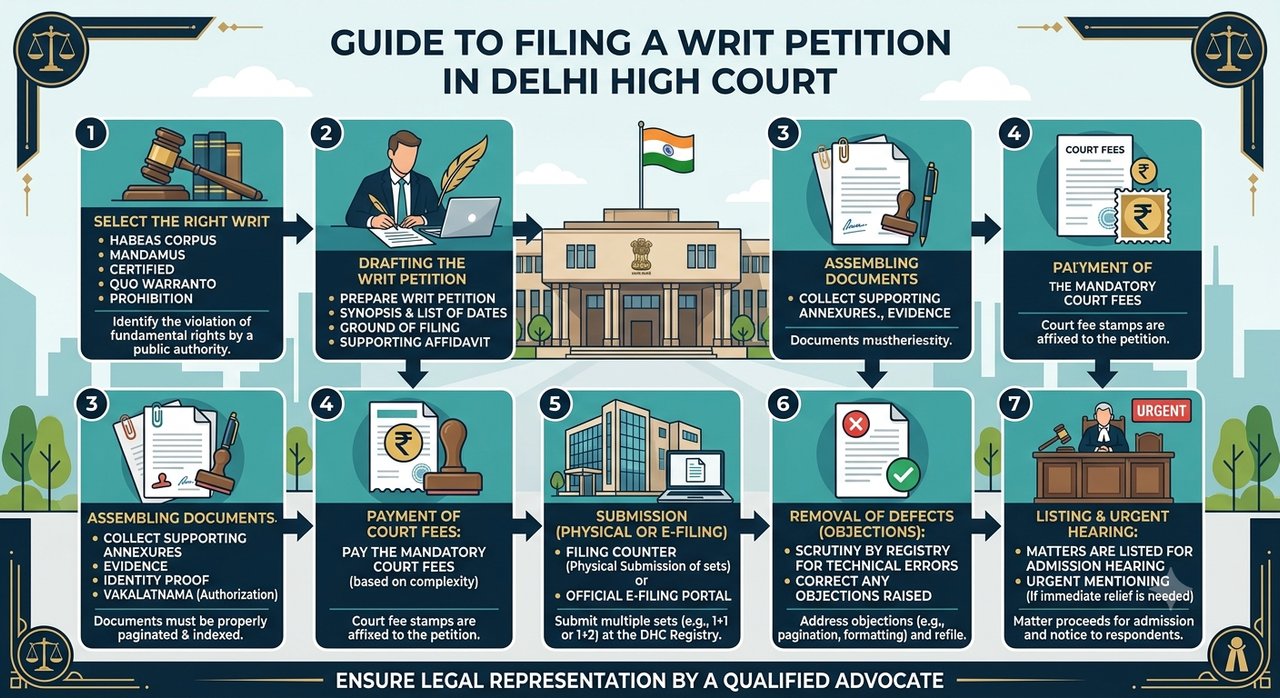
Learning how to file a writ petition in the Delhi High Court involves understanding the type of writ you need, the reasons for filing, the documents required, and the process for filing.
The Delhi High Court can use its constitutional power to issue writs in the right cases.
You can file a petition yourself or through a lawyer, as per the rules.
A writ petition is not simply a regular civil or criminal case.
The person applying must show a valid legal reason for using the High Court's writ power.
What Is a Writ Petition?
A writ petition is a way for a person to get legal help from the High Court.
It can be for a constitutional or legal issue.
Some common types of constitutional writs are:
- Habeas Corpus
- Mandamus
- Certiorari
- Prohibition
- Quo Warranto
The right type of writ depends on the issue and the rights involved.
When Can You File a Writ Petition in Delhi High Court?
You can file a writ petition when there is a need for the High Court to step in.
Some examples are:
- Challenging an administrative decision
- A public authority not doing its duty
- Violating legal or constitutional rights
- Challenging an action of a statutory body
- Service-related issues
- Government or regulatory decisions
- Matters related to public authorities
- Other cases that fall under the High Court’s writ power
Whether you can file a writ petition depends on the facts, the law, the court's power, and other available options.
Step 1: Know the Right Writ
The first step is to decide what kind of relief you need based on the law.
For example, mandamus might be used if a public body isn't fulfilling its duty.
Certiorari can be used to challenge a decision.Other writs apply to different situations.
A lawyer can help you figure out the right type of legal remedy.
Step 2: Check the Court's Jurisdiction
Before filing, you need to make sure the Delhi High Court can handle your case.
A lawyer would look at:
- Where the authority involved is based
- The reason for the action
- The order or decision being challenged
- The people involved
- The relevant law
- Any earlier steps taken
- Other possible legal options
Filing in the wrong court can cause problems with the process.
Step 3: Create the Writ Petition
The petition should clearly explain the facts, the legal reasons, and what relief you want.
Delhi High Court rules say that a civil writ petition should have the name and description of the person asking, the type of relief they want, and the reasons for their request.
This should be supported by an affidavit confirming the facts.
The petition should tell the story in a clear and chronological way.
Step 4: Prepare a Synopsis and Chronology
The current rules require a synopsis and a chronological summary with the facts.
These documents help the court understand the background of the case and the order of events.
The chronology should include only the important dates and events needed to understand the case.
Step 5: Gather Supporting Documents
Depending on your case, you may need to include:
- The order you want to challenge
- Government communications
- Notices
- Representations
- Previous court orders
- Applications to authorities
- Correspondence
- Official records
- Agreements or contracts if relevant
- Proof supporting your case
- Other relevant documents
Make sure all documents are properly organized and correctly referenced in the petition.
Step 6: Mention Past Proceedings
You must state whether you have previously filed a similar case with the Supreme Court or any High Court.
If you have, include copies of the related petitions and orders with your filing.
This is important to be honest about any earlier court actions.
Step 7: File the Writ Petition
The Delhi High Court allows you to file a petition either by yourself or through a lawyer based on the applicable rules.
The court also has an online system for filing petitions.
Its current e-filing resources include e-filing rules, FAQs, case categorization information, common objections, and filing tutorials.
Depending on the matter and the applicable procedure, the filing may involve the prescribed online filing process.
Step 8: Pay Applicable Court Fees and Complete Filing Requirements
The filing must follow applicable court-fee and procedural requirements.
The exact requirements can vary depending on the type of writ petition and the proceeding.
A lawyer or filing professional can review the current requirements before submission.
It is advisable to check the latest High Court rules and filing instructions rather than relying on outdated fee or document lists.
Step 9: Respond to Filing Objections
After filing, the Registry may raise objections about procedural or documentary issues.
The Delhi High Court provides a list of common objections as part of its e-filing resources.
If objections are raised, they generally need to be addressed, and the matter should be re-filed according to the applicable procedure.
The Delhi High Court's FAQ states that an objected case has to be re-filed after removing the objections within the prescribed period, subject to the applicable rules.
Step 10: Listing and Hearing
After the filing and registration process, the matter may be listed before the appropriate Bench.
At the hearing stage, the Court may:
Issue notice
Ask for a response from the respondent
Grant interim relief when appropriate
Order the production of records
Give procedural directions
Hear arguments
Decide the petition
The result depends on the facts, legal arguments, documents, and submissions made before the Court.
Urgent Writ Petition Filing
Some writ matters may require urgent consideration due to the nature of the relief or potential immediate consequences.
The Delhi High Court currently states that urgent filing has separate procedures, and urgent filings at the filing counter are subject to timing and court permission requirements.
Urgency should be properly explained and supported, not just assumed.
Documents Required for a Writ Petition
A typical writ petition may need:
Writ petition
Synopsis
List of dates and events
Memo of parties
Affidavit
Impugned order
Relevant notices
Representations
Previous orders
Supporting documents
Annexures
Proof of relevant facts
Details of previous proceedings
The exact documents depend on the subject matter of the writ petition.
Role of a Writ Petition Lawyer in Delhi
A writ petition lawyer in Delhi can help with:
Checking whether writ jurisdiction is appropriate
Identifying the relevant legal grounds
Deciding on the appropriate relief
Checking jurisdiction
Preparing the writ petition
Preparing the synopsis and chronology
Organizing supporting documents
Completing the required filing steps
Addressing Registry objections
Representing the petitioner during hearings
Legal advice is especially helpful when the matter involves complex constitutional, administrative, or statutory issues.
Common Mistakes to Avoid
When learning how to file a writ petition in the Delhi High Court, avoid:
Filing without checking jurisdiction
Using an inappropriate writ remedy
Hiding previous proceedings
Failing to include important orders
Presenting facts without a clear chronology
Ignoring limitation or delay issues
Filing incomplete documents
Failing to address Registry objections
Asking for relief that is not legally valid
Using outdated filing rules
Careful preparation can help avoid unnecessary procedural problems.
Conclusion
Knowing how to file a writ petition in the Delhi High Court involves identifying the correct legal remedy, establishing jurisdiction, preparing the petition and supporting documents, following current filing rules, and responding to any Registry objections.
The Delhi High Court currently offers online e-filing resources and specific guidance for writ petitions.
Since filing rules and court instructions can change, it is important to check the latest applicable rules before filing.